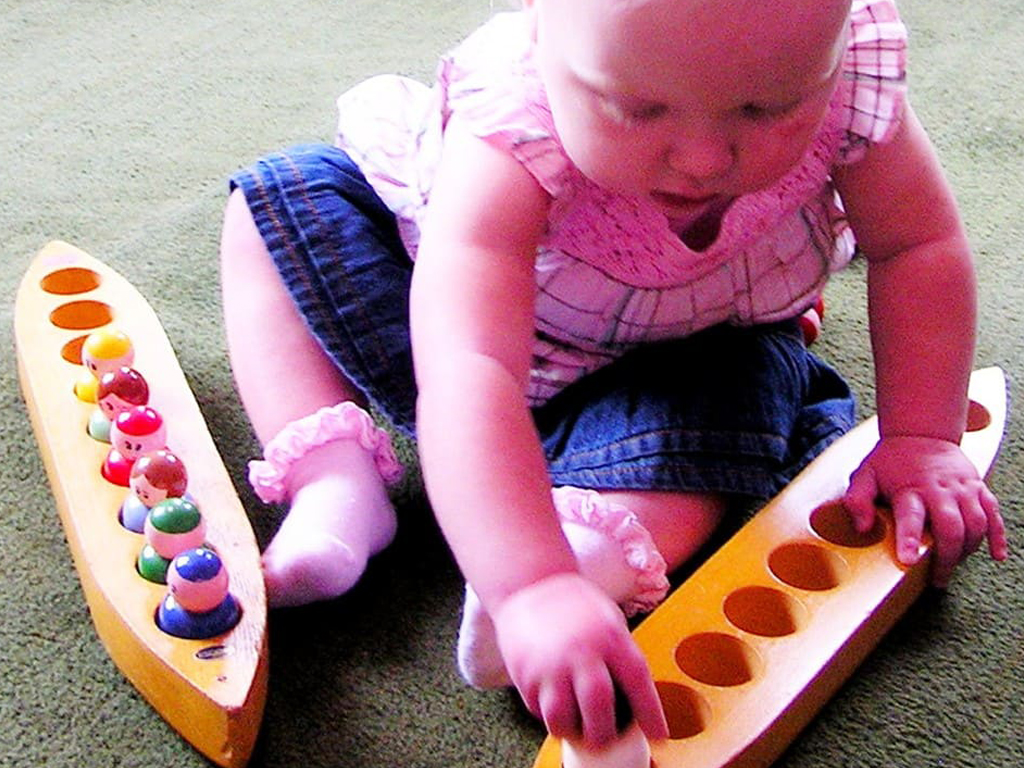
A collection of papers for a teachers’ course in 1976 which cover the theoretical basis of each of the learning-how-to-learn tools, and how to facilitate their development in practice
Session One
Introduction - Excerpt
This brief course is intended to introduce the practising teacher to a philosophy and practical approach to education, in particular to the education of unusual children, which will probably be unfamiliar…
Clearly there is much scope for clarification and development of the idea of sorting itself. As with matching, visual sorting has been used in these papers as the exemplar, very little attention being given to haptic, acoustic or olfactory sorting…
Praxic Understanding and 'Brick-Building' - Excerpt
… ‘praxic’ perception … an increasing understanding of space and of the movements of objects within that space … built up of accumulations of simple perceptions occurring one after the other …
The Evolution of Constructive Praxis and the Practical Teaching of 'Brick Building' - Excerpt
The ability to understand the positional, spatial and orientational relationships existing between objects has, like all other human understanding, its main origins in the early bodily movements.
Development of the Experience-Gathering Equipment - Excerpt
‘Fundamental Understanding’ is … that capacity … whose function … is … to ensure the survival of the organism. The greater the variety of habitats and … circumstances … the more unspecialised and pluripotential [the] structure and adaptive abilities …
Introduction to Sequencing and Seriation - Excerpt
… a sequence may be primarily rhythmic, springing from the temporal spacing of the events or primarily ordered, arising from the temporal order of the events …
This paper is … about … two separate mental processes … two different kinds of verbal understanding, namely, understanding the speech of others and understanding one’s own speech.
Geoffrey Waldon spent his final years working on his book. Although largely unfinished, these draft sections represent the most fully worked out form of his ideas.